(Even If They Don’t Know Where to Start)
One of the most common things I hear from students when I say “write a story” is this: “Miss, I don’t know what to write.”
They’re not lazy or unimaginative. They don’t have a structure to hold their ideas yet. Once you give them that structure, the stories come – sometimes faster than you can believe.
Over the years, I’ve used two frameworks in my classroom that work really well at different stages. Today I’m sharing both of them with you, along with tips for when to use each one.
Whether you’re a teacher planning a lesson, a parent helping with homework, or a student reading this on your own, by the end of this post, you’ll have a clear, simple system for writing any narrative story.
Let’s go.
Method 1: The 5-Sentence Mini Story
This method is perfect for beginners, young writers, and timed writing tasks. It strips storytelling down to its most essential shape: a beginning, a middle, and an end – in exactly five sentences.
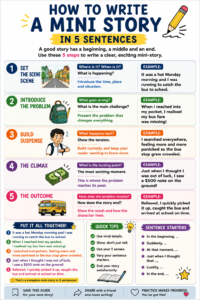
Every great story, no matter how long, follows the same basic arc. This method helps students see that arc clearly, then practice it quickly. Here’s how it works:
Step 1 – Set the Scene
Introduce the time, place, and situation in one sentence. Ground your reader immediately.
Example: “It was a hot Monday morning and I was running to catch the bus to school.”
Step 2 – Introduce the Problem
Present the problem that changes everything; this is what makes the story interesting.
Example: “When I reached into my pocket, I realised my bus fare was missing!”
Step 3 – Build Suspense
Keep your reader curious. This is where emotion and urgency come in.
Example: “I searched everywhere, feeling more and more panicked as the bus stop grew crowded.”
Step 4 – The Climax
This is where the problem reaches its peak; the moment everything could go right or terribly wrong.
Example: “Just when I thought I was out of luck, I saw a $500 note on the ground!”
Step 5 – The Outcome
Show the result and the character’s emotional response. End with a sense of resolution.
Example: “Relieved, I quickly picked it up, caught the bus and arrived at school on time.”
🌟 Quick Tips for Better Mini Stories:
- Use vivid details; don’t just say “I was scared,” show it.
- Show, don’t just tell.
- Use your 5 senses to bring the scene alive.
- Vary your sentence starters (try: Suddenly… / At that moment… / Luckily…)
- End your story satisfactorily; the reader should feel something.
The 5-sentence mini story is a fantastic warm-up tool. You can use it at the start of a lesson, as a timed activity, or as a daily writing habit. Once students are comfortable with this structure, they’re ready to go deeper.
Method 2: The F.O.C.U.S. Framework
When students are ready to write longer, more developed stories – for a class assignment, an exam, or a creative piece – the F.O.C.U.S. framework is the next step up.
F.O.C.U.S. stands for: Focus, Organize, Create, Use, Share. It’s a planning and writing tool that helps students think through their story before they write it, so they don’t run out of ideas in the middle.

F – Focus on Your Story
Before you write a single word, get clear on your story’s core idea. One sentence should be enough to describe it.
Example: “My story is about a student who almost missed an important exam.”
O – Organize Your Ideas
- Setting – Where and when does it happen?
- Characters – Who is in the story?
- Problem – What goes wrong?
- Events – What happens as a result?
- Solution – How is it resolved?
C – Create Your Story
- Add descriptions that paint a picture.
- Use your five senses.
- Show the action; don’t just list events.
- Add feelings; let the reader experience the emotion.
U – Use the Right Language
- Use strong, precise verbs (sprinted instead of ran).
- Vary your sentence starters.
- Include dialogue if it fits.
- Use connectives: then, suddenly, but, so, because…
S – Share Your Story
- How does it end?
- What is the lesson or message?
- How do the characters feel at the end?
🌟 Remember: Plan before you write. Keep your story clear and interesting. Use details to paint a picture. End your story satisfactorily.
Which Framework Should You Use?
Here’s a simple guide:
- Use the 5-Sentence Mini Story when you need a quick, complete story; for warm-ups, practice exercises, timed writing, or younger students just learning story structure.
- Use F.O.C.U.S. when you’re writing a full narrative for a class assignment, an exam essay, or any story that needs more depth, detail, and planning.
Think of them this way: the 5-Sentence method is a sprint, and F.O.C.U.S. is a marathon. Both are worth practising. And both will make you a stronger storyteller.
The best part? Once students learn these two frameworks, they stop staring at the blank page. They have a plan. And a writer with a plan is a writer who writes.
Want Printable Worksheets for Your Students?
I’ve turned both of these frameworks into ready-to-use student worksheets; perfect for classroom use, homework assignments, or independent practice. No prep needed. Just print and go.
The resource pack includes guided planning sheets, sentence starter lists, a self-editing checklist, and a teacher answer key.
Grab the Resource Pack Here.
Available on Selar and Gumroad. Instant download.
Have a question about teaching narrative writing? Drop it in the comments below; I read every one. And if this post was helpful, save it or share it with a teacher friend who’d love it too. 💛