Do you ever find that your body is weary, yet your mind continues to race? If this resonates with you, this post will explain methods to stop overthinking at night and achieve the restful sleep you need.
“It’s 2 am, and you’re replaying a conversation from three years ago. You know you need sleep, but your brain has other plans.”
Nighttime overthinking is one of the most common sleep disruptors. The moment your head hits the pillow, your brain shifts into overdrive, analyzing, worrying, and replanning everything. This isn’t an intentional act. It’s your nervous system doing what it was designed to do: solve problems. The trouble is, 2 am is rarely the right time for problem-solving, but your brain doesn’t know this.
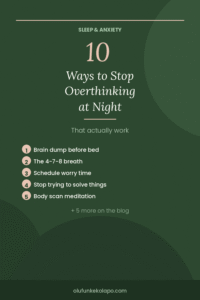
The good news is that this pattern is changeable. And here are 10 science-backed and practically tested strategies to quiet your mind at night.
Do a “brain dump” before bed to stop overthinking at night
Always keep a notebook on your nightstand. About 30 minutes before bed, write down everything spinning in your head – worries, to-dos, and unfinished thoughts. Research from Baylor University found that writing a to-do list before bed helped people fall asleep significantly faster. This act of writing signals to your brain that these thoughts are captured and no longer need active monitoring. You’re offloading them from your mental RAM.
Buy on Amazon

Schedule a “worry time” earlier in the day
Here is another step you can take to stop overthinking at night. Instead of fighting your thoughts at night, give them a designated home. Set aside 15–20 minutes in the afternoon – only in the afternoon – to worry on purpose. I know this may sound weird, but so does lying awake at 2 AM when you should be sleeping, replaying past events, or overanalyzing your every decision. So, write down your concerns, sit with them, then close the notebook. When anxious thoughts arise at night, your brain has somewhere to send them: “I already handled that. It’s written down. Tomorrow at 4 pm, if I still need to, I’ll think about it.” This technique, known as stimulus control, is a core part of Cognitive Behavioural Therapy for insomnia.
Try the 4-7-8 breathing technique
This breathwork method, popularized by Dr. Andrew Weil, activates your parasympathetic nervous system, the “rest and digest” mode that counteracts anxiety. Here’s how: inhale quietly through your nose for 4 counts, hold your breath for 7 counts, then exhale completely through your mouth for 8 counts. Repeat 3–4 cycles. The extended exhale is the key: it slows your heart rate and signals safety to your nervous system. Many people find it works in as few as two cycles. And I am one of the many people who have tried and still trying it. It works.
Stop trying to “solve” things at night
Here’s the truth most overthinkers need to hear: almost nothing you’re worrying about at midnight requires a solution right now. The biggest truth is that there is hardly any problem you can solve at that time of the day anyway, except to add more problems to worry about later. However, your brain thinks it’s being productive by running through scenarios; it’s not. It’s borrowing stress from tomorrow, next week, and next year. So, when a thought arises, practice saying: “This is a real concern. It does not need to be solved right now. I’ll have this thought tomorrow.” This way, you’re not dismissing the worry; you’re postponing it to a time when your prefrontal cortex is actually working properly.
Almost nothing you’re worrying about at midnight requires a solution right now.”
Use a body scan meditation
A body scan moves your attention away from looping thoughts and anchors it in physical sensation; a much harder loop for anxiety to maintain. Start at the top of your head and slowly move your awareness down your body, noticing (not judging) any tension, warmth, or tingling. By the time most people reach their feet, they’ve either relaxed significantly or fallen asleep. The Insight Timer app has hundreds of free guided body scans ranging from 5 to 45 minutes.
Lower your bedroom temperature
This one surprises people. Your body needs to drop its core temperature by 1–2 degrees Fahrenheit to initiate sleep. If your room is too warm, that process is disrupted, and a warm, stuffy environment also makes anxiety feel more intense. Sleep scientists recommend a bedroom temperature between 65–68°F (18–20°C). Even just cooling your hands and feet (blood vessels there help regulate core temp) can speed up sleep onset by 20 minutes.
Listen to a sleep story or podcast
For overthinkers, silence is the enemy. I actually realized this myself a long time ago. When there’s nothing to listen to, the brain fills the void. A gentle, low-stakes audio experience, a sleep story, a slow nature documentary narration, or a “boring” podcast gives your brain just enough to chew on so it doesn’t spiral. The keyword is “boring.” You want something that occupies the verbal processing part of your brain without being engaging enough to keep you awake. I have been using some sleep-time prayers I found on YouTube. I mouth the prayers after the voice until I fall asleep. Now, some nights I do not even need them. YouTube has a huge library of this content for free.
Name your thoughts, don’t fight them
Have you heard? Fighting a thought at 2 am is like arm-wrestling quicksand; the harder you push, the deeper you sink. Instead, try labeling. When a thought arises, simply name it: “That’s a worry about work.” “That’s a fear about money.” “That’s me replaying that conversation again.” Research in affective labeling (naming emotions and thoughts) shows it reduces the emotional intensity of thoughts by increasing prefrontal activity and decreasing amygdala reactivity. You’re not the thought. You’re the one noticing it.
Cut off screens 45 minutes before bed
You’ve probably heard this before, but the reason it works goes beyond blue light. Screens deliver unpredictable emotional stimuli: a stressful news headline, an annoying comment, an unanswered email that activates your stress response right when you need it least. The blue light suppresses melatonin production, yes, but the psychological activation is equally damaging. Replace that last 45 minutes with reading a physical book, light stretching, journaling, or even just sitting quietly. Your brain needs a transition ritual, not an abrupt shutdown.
Make peace with being awake
This is counterintuitive but crucial: one of the biggest causes of night time anxiety is the fear of not sleeping. “If I don’t sleep, tomorrow will be ruined.” That thought alone will keep you awake. I used to feel this way before, and the anxiety of everything that will happen the following day or go wrong if I don’t sleep will make it even harder to go to sleep. Research in sleep restriction therapy shows that reducing sleep anxiety is often more effective than any sleep hygiene tip. Try this reframe: “Even resting quietly with my eyes closed is restorative. I don’t have to force sleep.” Paradoxically, removing the pressure to sleep is one of the most effective ways to actually fall asleep.
“Resting quietly with your eyes closed is already restorative. Remove the pressure, and sleep often follows.”
Nighttime overthinking doesn’t have to be your norm. These strategies work best when practiced consistently, not just on the worst nights, but as daily habits that gradually lower your baseline anxiety. Select two or three options from this list and commit to them for two weeks before re-evaluating.
Which one will you try tonight?