
Most students state opinions. Strong writers persuade. Learn how to write a persuasive paragraph with a hook, a clear stance, strong reasons, and a strong close.
Some years ago, a student handed me a paragraph that I still remember. Her ideas were thoughtful and honest, yet nearly every sentence began with “I think” or “I feel.” When I asked her why she wrote that way, she told me she was simply being honest, and since those were her real feelings, they should count for something. I understood her completely.
Her honesty was not the problem. The problem was that a feeling, however sincere, is not yet an argument. In persuasive writing, readers and examiners do not reward how strongly you feel. They reward how well you prove your point. This post will show you how to turn an honest opinion into a paragraph that persuades.
Consider this sentence:
“School uniforms are good because it creates identity.”
This sentence is an opinion, and it also contains a grammar error (“uniforms” is plural, so the sentence should say “they create”). More importantly, it does not persuade anyone. It makes a claim, offers a vague reason, and stops. A reader who disagrees has no reason to change their mind.
After more than 15 years of marking persuasive essays, I have noticed that students rarely lose marks because their ideas are weak. They lose marks because their ideas are poorly built. This post shows you how to fix that, one step at a time, using the school uniform debate as our example.
Why Most Persuasive Paragraphs Fall Flat
Before we learn the solution, let us identify the three most common problems I see in student writing:
- The paragraph begins with a demand. The student opens with “Schools should require uniforms,” which gives the reader no reason to keep reading.
- The reasoning is thin. The student gives a reason but never explains why it matters.
- The ending is hesitant. The student concludes with “That’s why I think…,” which weakens everything that came before.
The solution is a clear structure. A strong persuasive paragraph contains five essential parts:
- A hook
- A clear stance
- A strong reason
- An explanation of why it matters
- A strong closing
Let us build each part.
Step 1: Start with a Hook, Not a Spoiler
Many students believe they should state their exact position in the first sentence, for example:
“Schools should require students to wear uniforms.”
This approach is direct, but it usually fails as a hook for three reasons:
- It is a spoiler. It gives away the ending before the reader has a reason to be curious.
- It sounds repetitive. It often repeats the essay prompt, which examiners have already read.
- It puts up a wall. Readers who disagree may stop listening because you opened with a demand instead of an invitation.
Now compare it with a magnetic hook:
“Walk down any school hallway, and you may mistake it for a high-fashion runway rather than a place of learning.”
The reader now has a picture in mind and wants to know where the writer is going. That curiosity is what a true persuasive hook creates.
Quick fix: If your first sentence could be copied directly from the question, rewrite it. Open with a vivid image, a surprising observation, or a question that makes the reader think.
Step 2: Make Your Stance Unmistakably Clear
Once your hook has captured attention, your reader should never have to guess where you stand. Follow the hook immediately with your position:
“For this reason, schools should require students to wear uniforms.”
Notice that the phrase “For this reason” connects the hook to the stance. This small transition keeps the paragraph flowing instead of sounding like two separate ideas.
Common mistake: Writers often bury their stance in the middle of the paragraph. Place it directly after your hook so the examiner finds it quickly.
Step 3: Give a Strong Reason
A claim without support is only an opinion. Back your stance with a specific, focused reason:
“Uniforms reduce unnecessary competition over clothing and help students focus on learning instead of appearances.”
A strong reason targets the core of the issue. Notice that this sentence does not say “uniforms are good.” It names exactly what uniforms do and what problem they solve.
Common mistake: Using vague words such as “good,” “bad,” “nice,” or “helpful.” Replace them with precise verbs and outcomes, such as “reduce,” “prevent,” “encourage,” or “protect.”
Step 4: Explain Why It Matters
This step is where real persuasion happens. Anyone can list a benefit, but a skilled writer connects that benefit to a value the reader cares about. Consider these two sentences:
“When students are not worried about keeping up with expensive fashion trends, they are more likely to feel included and concentrate on their schoolwork.”
This sentence explains the effect of the reason. You could extend the idea further with a value-driven statement such as:
“A school should be a place where students are valued for their character and academic effort, not for the labels on their clothes.”
This type of sentence moves your argument from a surface-level observation to a principle that most readers will agree with. When your reader agrees with your principle, they are much more likely to accept your conclusion.
Quick fix: After every reason you write, ask yourself, “So what?” Your answer to that question is your explanation.
Step 5: Finish with Confidence
The closing sentence is the last impression you leave with your reader, so it should sound confident and authoritative. Avoid hesitant phrases such as “That’s why I think…” or “In my opinion…,” because they signal doubt.
- Weak closing: “That’s why I think uniforms are good.”
- Strong closing: “School uniforms create a more focused and inclusive learning environment, making them an important part of every successful school.”
The strong closing restates the argument in fresh words, names the benefits, and ends with a declaration instead of an apology.
Sample Persuasive Paragraph
When we combine all five steps, the result is a complete and high-scoring paragraph:
Walk down any school hallway, and you may mistake it for a high-fashion runway rather than a place where young minds are meant to learn and grow. For this reason, schools should require students to wear uniforms. Uniforms reduce unnecessary competition over clothing and help students focus on learning instead of appearances. When students are not worried about keeping up with expensive fashion trends, they are more likely to feel included and concentrate on their schoolwork. School uniforms create a more focused and inclusive learning environment, making them an important part of every successful school.
Read the paragraph again and label each sentence. You will find the hook, the stance, the reason, the explanation, and the closing, in that order. This is a model you can reuse for almost any persuasive topic.
Your Self-Check List Before You Submit
Use these questions to review any persuasive paragraph you write:
- Does my first sentence create curiosity instead of repeating the question?
- Is my position stated clearly and without hesitation?
- Have I given a specific reason instead of a vague one?
- Have I explained why my reason matters to the reader?
- Does my final sentence sound confident, with no “I think” or “I feel”?
If you can answer yes to all five questions, your paragraph is ready.
Your Turn: Practice the Skill
Reading about persuasive writing is helpful, but writing is what builds the skill. Here is your challenge:
Write a persuasive hook for this prompt: “Should homework be banned?”
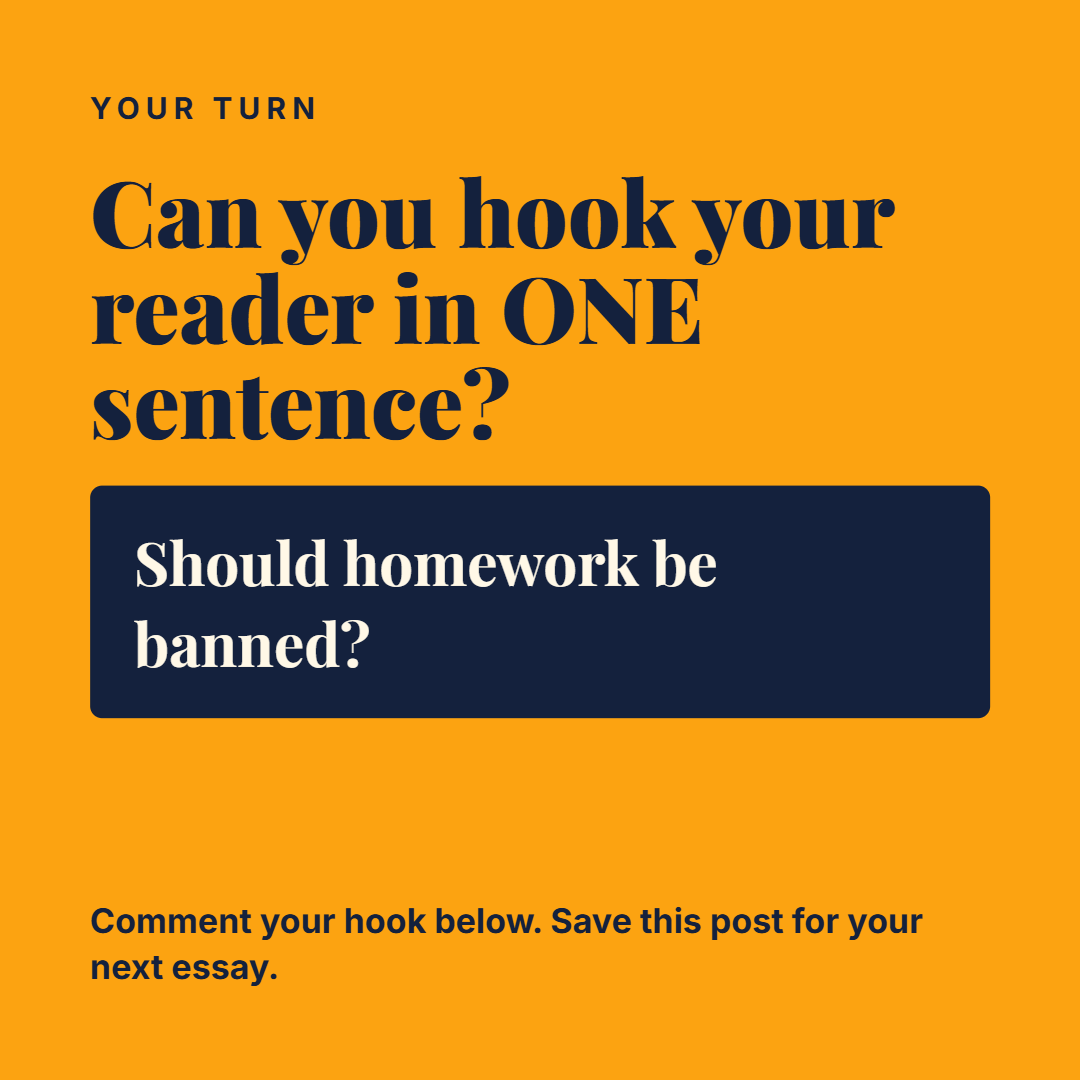
Can you grab your reader’s attention in just one sentence? Remember that a strong hook does not announce your stance. It creates a picture, a surprise, or a question that makes the reader want more.
Take the Next Step
Do not let this lesson stay on the screen. Here is how to turn it into higher grades:
- Comment your hook below. Share your best one-sentence hook for the homework prompt. I read the comments, and the strongest hooks may be featured in a future post.
- Bookmark this post. Return to it the next time you have a persuasive essay, an exam, or a School-Based Assessment to complete.
- Subscribe to the blog. Every week I share clear, practical writing lessons designed to help you earn higher grades, so that you never have to guess what examiners want again.
- Book a tutoring session. If you want personal feedback on your paragraphs, I offer one-on-one CSEC English tutoring. Reserve your session here.